Two items have been held up pending 10 weeks of illness then need to create portfolio work.
These are the Video that should have been made over the break and the Critical Review of Practice CRoP.
These have been taken together, but oddly manage to support the work. The following PDF is the mind map. A CRoP is a CRoP but it has to be about something so the overview of working practice and methodology is given as a mind map. The CRoP requirement (or part of) has been mapped onto it and requires further development like issuing a draft. However, there is some referencing to other practitioners still in research. Despite having this for earlier incarnations of the work (in earlier study Modules) the work has progressed on so time for the update.
To an extent I can argue about originality and a need to mask off external influences as the work is quite unique in its standing as a branch of Art based on Science. As blogged previously I’m never surprised anymore to find original thought crop up in other places of which two examples could be cited.
Top left hand in the mind map is the Critical Review of Practice from an earlier module assignment.
The bottom left hand is a storyboard outline for a useful video resource that is being created. (This proved very helpful to visitors to the summer exhibition).
Above this is the connection to the CRoP linked to Ghost Abstract Figurative Themes. While Ghosts per se have been dropped since the review with a book designer, the landscapes remain ghost images.
Practice location top right is the piece being updated for this dynamic project. It does need to settle down urgently prints, book, portable exhibition and talk to be worked on.
There is quite a challenge here as none of the work has been subcontracted to printers or anyone else so all of the skills from the photography through to all branches of making have been absorbed and this alongside all of the marked assignment work. For anyone wishing to embark on an MA Photography Course they may wish to consider how much work to outsource to specialists. Personally, outsourcing the Book making to an online offering is not preferred over an artists book dummy and hiring a book designer would lose some of the original intent to someone else’s view of what the market would stand. The work is still too dynamic for this.
Bottom right is the remainder of the CRoP assignment requirement, which pertains to the public showing.
In terms of evidencing the work as mentioned here in an FMP lecture video then on the subject of gaining public feedback, there is a need to reach out to practitioners to elicit attendance or somehow provide comment on the work.
I now have a date of the Easter Weekend for showing the work over four days at Amersham Studios tradesecrets.live Only now can approaches be made by reaching out.
As image-making is fundamental and has been a major focus, work has been flooding forward and is now starting to receive critique (two critiques were missed through technology issues).
There is scope for an earlier pop-up exhibition at the same location. No promises yet. Details will be published and a campaign run via Instagram account foto_graphical and Facebook.
A detail was examined of the source of image glow in humans
Michael Turner based on UV image by Dr J Crowther
Access to imaging scientists led to emanation being discarded as it is undetectable. Instead, attention is brought to body reflection in the visible light spectrum. The scope was introduced for a secondary effect caused by visible light having triggered bacterial fluorescence.
Further research and reflection have guided change and resulted in the adaption of digital darkroom processing that now uses simpler steps that are easier to manage and more flexible in fine-tuning the healing wound image.
Motherline (mtDNA) and Glow
The ancestral basis of identification between individuals had been established through the Motherline as an image Aura or Emanation.
The method still stands, but as trace rather than direct emanation. Trace is in cellular heat created by mtDNA / ATP processes. This is largely through the increased blood supply at a healing wound. Blood contains levels of mtDNA as do all of the other cells but does not contain nuclear DNA. Direct emanation by humans is a measurable process but it is only detectable using scientific instruments.
We have to discount bacterial fluorescence. Bacteria are necessary to our existence and are present in great numbers alongside our human cells. However, bacteria are not genetically human and so the glow created by bacterial fluorescence cannot be attributed to the ancestral link but to the general population instead. Bacterial glow does not develop the psychological process of identification with ancestors.
Equivalence
Equivalence has been found between:
Process A
In HDR Tone
Compress (gamma) and simplify (slider)
In Levels
Spread and decompress (gamma)
Process B (new)
Simplify (ACR Clarity)
Colour layer | Luminance
In Levels
Spread
Comparison A versus B
The effects are equivalent and the number of steps the same. Method A can lose image data by compressing and decompressing where Method B preserves data. Method B. This gives more scope to subtly enhance the through colour channel (RGB) adjustments.
Conclusion
Processing Method A (HDR Tone) remains valid although there is no direct detection of IR. Method B can be adopted in its place for improved data retention and colour processing. The effect applied can be more readily followed.
Visible light detection is what is present and derives mainly from the blood supply to and around the healing wound and is connected to Motherline mtDNA although. As nuclear DNA is not presented in blood this makes the detection a close.
The name Motherline is introduced into blog usage below as it is now being adopted. Motherline refers to the photography of healing wounds and the resultant abstract glow images from a digital post method.
Imaging Science
Long-awaited, the Symposium on imaging science took place at the University of Westminster. on Saturday 14 December 2019.
The opportunity existed to be introduced and meet people from the scientific and medical community. A number of those present were from the Kodak or Ilford companies and from the Universities or other professional bodies.
Imaging science participants were generous in giving their time to listen to the Motherline image glow and the post-processing techniques used.
Michael Turner based on UV image by Dr J CrowtherMichael Turner based on UV image by Dr J Crowther
A processed image was created from a UV image portrait captured after the Symposium talk Imaging the Skin – UV, visible light and IR
As preparation for attending the conference, research was conducted into image compression and decompression, as the techniques used in enhancing glow in Motherline photographs.
It became possible to describe to a medical forensic imaging expert the art interpretations of glow in healing and in return obtain vital and conclusive feedback.
A detailed discussion was had on the processing steps for potential infrared detection. The wavelengths for emanations from healing wounds at human body temperature are very long wavelength, well beyond consumer camera detection capability. The conclusion was that there will be no detection of IR emanation.
Where IR is received by a smartphone camera, in the example of the domestic remote control, the wavelength is short enough to be detected depending on the exact optics of a specific camera, lens and bayesian filter.
Blood Supply |Bacterial Fluorescence
However, in the project photography there is a glow present, so where does it come from? A general news article explains (Hrala, 2016).
Foremost is the presence of blood supply around a healing wound.
Potentially there is fluorescence present. Bacteria gather in the region of a healing wound. When excited by an external light source a glow will appear in the visible spectrum. A Japanese research paper examines this in detail (Koboyashi, 2009)
Detection used a cooled CCD in conditions of complete darkness. With a prosumer camera, there is no detection of direct bodily emanation from a healing wound. Rather than emanation, an external light source excites the bacteria and produces fluorescence in the visible light spectrum.
Both of these effects are the likely cause of the glow that appears in the photo project images.
The intention is to deliver something art-based (rhyme or graphic text or image titles) over the upcoming period between terms as noted in the Final Proposal. An intention is to experiment to discover if contextualisation and visual language can be built with Recombinant Rhymes or DNA Art.
The idea is to use imagination in selecting words like TELEOLOGICAL that contain DNA base letters ACGT and combine them for effect, perhaps making a video with a reading of a rhyme. Words are intended to be selected for their connection to narratives of the project.
Select from the following ACGT words for some connected meaning:
Examples:
Advocating
Fracturing conflagrations
Countervailing
Lethargic contagiousness
Interestingly, the validated list contains the terms Abstracting and Photographic.
Project naming
In short, “Motherline” is the name presently chosen. This is less politically charged than the earlier proposed project name “Matriarchy”.
Matriarchy like patriarchy has political overtones, so is not so attuned to the themes of the work.
The previous portfolio settled on monochrome and red. It is interesting to re-discover the following quotation from an external to MA course, The Power of Colour. KLC School of Design.
The following colour interpretations are there to be agreed or disagreed with.
“According to Benjamin Whorf’s Linguistic Relativity Hypothesis, the language a person speaks determines how he or she experiences the world. This can affect how someone perceives colour. For example, the Shona language in Zimbabwe does not distinguish between red and orange. There seems to be a pattern, however, in the order in which all languages recognise colours: all languages appear to have a name for black and white, and if a third colour is recognised, that is red, and next comes yellow or green. “
“People who live in sunny climates prefer warm, bright colours, whereas those from places with less sunlight prefer cooler, less saturated colours.”
Quotations from KLC School of Design
There is a useful article What Colors Mean in Other Cultures. This proved useful in the past and so is brought into the scope of this blog post.
Colour Psychology has been extensively written about, and again here in Chivers and Wright. However, there is often a willingness to accept what is prescribed yet the verdict around any rules and interpretations is open in terms of there being no absolute scientific validity.
A re-exploration of the roots of Abstract in Bauhaus, Modernism, Post Modernism and Abstract Expressionism. Here, for now, a start is made.
This blog post serves as a reminder to revisit the developments that led to Abstract Art. This research was started in an earlier module. As there is a link to the chosen abstract genre for the final photo project, there is a reason to extend the reading.
Historic references are recorded here from external to MA studies:
Albers work gained mention in an external course on colour but did not gain mention within the scope of this MA blog other than a blog this week PHO705: Artist Jake Wood Evans. To right this here a quotation is taken verbatim from (Affron, 2012) Page 302 as it ties together a number of references:
“Itten’s tenure at the Bauhaus was notoriously marked by the increasing incompatibility between the Expressionist and esoteric impulses of Ittenand his cohort and the functionalist ethos for which the school would become known. That tension is latent in Josef Albers’s Gitterbild (Lattice Picture), also known as Grid Mounted … Working on this piece as a student in the glass workshop of the Bauhaus, Albers cut and arranged squares on manufacturers’ samples of glass within a regular metal lattice. On the one hand, this straightforward grid composition foregrounds the materiality and variety of industrially produced glass, divested of the conventional esoteric connotations of coloured glass panes, for example in church windows. (Albers had created a stained glass window for a church four years earlier, and he would have been thoroughly familiar with the mystical connotations of stained glass). And yet, as light passes through Albers’ grid, Kandinsky’s immaterial fantasy of unbounded colour returns, finding subtle expressions through the chromatic emanation of light.”
(Affron. 2012) Page 302
Gitterbild (Lattice Picture) / Grid Mounted Josef Albers
The above plate is from the book Inventing Abstraction (Affron, 2012)
Alfred Stieglitz
Stieglitz work (Birgus, 2002) Pages 44 and 45 have visual similarities with the earlier portfolio images created for the MA as well as the current crop of images. Interestingly the 4×5 print format is common.
[metaslider id=3845 cssclass=””]
Images – Alfred Stieglitz
Laslo Maholy-Nagy
Having read photographic theory expounded by this writer and artist, and now having viewed a particular image, a chord has been struck. It concerns the appearance of the Christian symbol of the cross as it recurred in earlier work in the build-up to the MA portfolios.
In memory of Sibyl Maholy-Nagy – Laslo Maholy-Nagy
Wassily Kandinsky
Kandinsky is linked in the quotation above and has been previously blogged.
Affron, M., Bois, Y. and et al (2012) Inventing Abstraction 1910-1925. 3rd 2014. Edited by D. Frankel. New York: Department of Publications Museum of Modern Art. Available at: http://www.thamesandhudson.com.
Birgus, V. et al. (2002) Die Kunst der Abstrakten Fotografie The Art of Abstract Photography. Edited by Jager Gottfried. Stuttgart, Germany: Arnoldsche Art Publishers.
There are different commercial services that provide DNA testing connected with ancestry. One service is mentioned here as they have an option to have a personalised book and that fits well with researching visual language of DNA. Two services were inspected:
This is a continuation of earlier research. It looks at a specific book product of commercial DNA testing. The idea is to gain awareness of public perceptions around DNA by examining the visual language used by a company promoting DNA testing.
This current phase of research is prompted by the order and eventual arrival of a personalised analysis “Your DNA Adventure” (LivingDNA, 2019).
The content is predicated on three types of DNA we possess.
Family Ancestry (autosomal DNA)
Motherline Ancestry (mtDNA)
Fatherline Ancestry (Y-DNA)
As the photo project majors on the Motherline (a term now preferred to matriarchy as it softens potential for feminist bias.
The motherline is highly stable over thousands of years and once a change does occur it is passed down to descendants. The top-level term used is Haplogroup within which exist Subclades.
Descriptive language then takes over preventing opaqueness and is a strategy noted elsewhere for keeping others engaged.
There is a very good reference section to explore.
Within the publication the visual themes range across:
trees on African savanna (covers)
Note: The visual references are probably best viewed as a publication rather than my translate to text here.
Bibliography
LivingDNA (2019) Michael Turner – Your DNA Adventure.
Following the visit to the Wellcome Museum, it was clear that others must be working in an area where art is created from science.
Artsci is the term coined in the book (Miller, 2014) where Artsci acknowledges a convergence of Arts, Science and Technology.
Colliding Worlds – How Cutting-Edge Science is Redefining Contemporary Art (Miller 2014)
The work in bulk extensively sells the market for Artsci, by giving innumerable personal reflections on individual contributor after individual contributor, yet this is rebalanced in the final chapter by doubts over the acceptance of Artsci in restricted / specialist galleries being deemed almost gimmicky as an art form. However, examples are made in the ending of the rejection of Picasso and the Impressionists who had to set up their own groups. And so it is left to the reader as to whether or not to take up the “cause” of Artsci.
Millar describes the technical evolution of technology in computing in this book (Millar, 2014). So much resonates with my early career in technology as a world in which artist and scientist no longer are viewed strictly different disciplines. Art and science and engineering are disciplines seen as having a conceptual touchpoint in terms of methodologies e.g. minimalism and cubism.
An electronic signal called a butterfly transform, photographed on Polaroid film, was one of my earliest technical visualisations. I designed and built an electronic circuit to automatically tune to a signal frequency of a type used to communicate with deep space satellites. The active tuning process was viewed on an oscilloscope and the overall capture presented on film. During development one of the early characteristics was that of a squegging oscillator which pulsed on and off due to design tolerance issue in this automatic circuit. This was around the time that a successful MSc application was made to study the subject of Cybernetics that involves the control of machinery using feedback and software controllers. A funding issue arose that prevented the place from being taken up. Besides this, an economic downturn occurred that would certainly have blocked an immediate return to research and development within the industry.
The book runs a direct parallel to my early involvement in computing, discusses the various technological art movements and the establishment of schools for such art.
The book also discriminates between Media and Fine Art the former being linked to crafts and it notes the rejection that occurred on many fronts.
However, with repeated incursions of technology into art and advances in the modern world, it is argued that contemporary art can no longer exist without the structures and knowledge of the scientific world and they are seen to combine.
Artists are seen to look towards science and without getting directly involved with expensive equipment instead read the ideas and then through contemporary art communicate these ideas. Scientists look towards artists to understand how they approach a topic e.g. Nils Bhor and the wave-particle dichotomy of physics and the resolution of this through Picasso and the advent of Cubism, where it is fine to have multiple perspectives present all at once.
The question has to be where does this lead to in terms of the Final photo project? Well, it resolves why the author takes a technological view of art and provides an independent and solid standing. The intent of the work becomes understood in the wider context.
The book identifies the avant-garde as being the convergence of art, science and technology and it is seen as an exciting frontier in Contemporary art.
There is a summary for Antony Gormley, his influences including in science, and his work which was on display in London during visits there.
Another outcome is a strengthened resolve so as to honour or be true to one’s life experiences. Otherwise work would remain conflicted.
Had this work been uncovered earlier in the course, there would have been the time need to develop programmed work such as animations. These would be over and above the glow images attributed to mtDNA. What there is also are elements of identification (determined through psychoanalysis).
The book has been difficult to put down and yet the historical side has to stop at some point to allow time for project progress.
Computational Biology – Human Proteome Folding
Following a career in research and development in electronics and computing, sometime later, there was a formative even if only a side involvement in grid computing donating spare machine cycles to do then return completed calculations to researchers in computational biology. This was in the search for new drug treatments.
Specifically, spare machine cycles were donated to human proteome folding projects. These projects are highly visual as protein formation and attachment is shape-dependent.
These projects go back to around 2004 and there is little visual material remaining. In lieu of this, a TEDtalk was discovered that ably shows the visuals (Dill, 2013).
For 50 years, the “protein folding problem” has been a major mystery. How does a miniature string-like chemical — the protein molecule – encode the functions of living organisms: how our muscles exert force, how our immune systems reject pathogens, how our eyes see our surroundings, how plants convert solar energy, and all the rest. Huge progress is being made. Moreover, these amazing nano-machines could play important roles in health and disease and commerce in the future.
(Dill, 2013)
What this post identifies is what is behind the intent in making the photo project.
Art of Now
Research uncovered a BBC Radio 4 broadcast Art of Now. (McNamee, 2019)
Recombinant Rhymes and DNA Art
The successful sequencing of the human genome has not only had huge implications for medicine, bio-technology and the life sciences – but it has also provoked a great and growing reaction among artists and writers.
Anna McNamee meets poets, visual artists and scientists collaborating creatively on the frontiers of DNA science in a genre that Pulitzer Prize-nominated author of AI Renaissance Arthur Miller calls Art Sci.
In Melbourne, the bio-animator Drew Berry tells how his dramatic but scientifically exact visualizations of cellular and molecular processes have earned him fans around the world – including the musician Bjork.
The poet Sue Dymoke and the structural biologist Pietro Roversi reveal how their creative partnership has resulted in a three-dimensional, topsy turvy poem called DNA Time that mimics DNA’s unique and complex structure.
In his lab, the Canadian experimental poet Christian Bök has successfully encoded his work into the DNA of a bacterium creating what is essentially a living poem.
While at the European Bioinformatics Institute near Cambridge, the artist and filmmaker Charlotte Jarvis and the scientist Dr Nick Goldman have stored music in DNA which they then suspended in a soap solution and used to blow bubbles, quite literally, bathing their audiences in music.”
(McNamee, 2019)
Drew Berry
Drew Berry is a biomedical animator at the Walter and Eliza Hall Institute of Medical Research in Melbourne, Australia. He produces animations of proteins and protein complexes to illustrate cellular and molecular processes (Berry, 2011).
Wikipedia
Animation Development
Berry describes the molecular level being sub-light wavelength and how he gained inspiration from the accurate scale drawings of David Goodsell:
Beyond this Berry incorporates measurements of cell dynamics and microscopic observations of larger cell structures to create his animations. His intent is to make work that viewers can take-in with avoidance of technical descriptions and acronyms which otherwise make the subject opaque and turn off the viewer (Berry, 2012)
Animations from Berry and molecular biologists and cell biologists:
Miller, A. I. (2014) Colliding Worlds – How Cutting-Edge Science is Redefining Contemporary Art. New York and London: W. W. Norton and Company. Available at: www.wwnorton.com
This research arises from a connection established with a geneticist. The value here is in the development of visual language for contextualisation of the photo project.
Mitotic Division is examined by augmented reality with the following app and educational workbook:
Note: Select English under the triple bar menu
The emphasis moved closer towards an interest in mitochondria explored in another recent blog post. While there is an abundance of archive images that explore the matriarchal lines of family, the visual context around genetics is being developed having been more restricted materially and in terms of ideas, which are constantly being expanded.
Use
The pdf says to print off the guidance – the app seems to work when reading the graphics directly from the screen graphics when Adobe Acrobat (or another reader is used).
Students are able to join the AOP. I met Nick at the 2018 Birmingham Photography Show. The guest lecture is well-timed as the Forth cohort begin to take their work public.
Your pictures your copyright
Copyright automatically belongs to you. Exceptions exist for images used in the US which need to be registered with the US Copyright Office USCO.
Cover exists for 70 years from the end of the year the author survives.
Assign is like selling your house. License is like rent.
Copyright exceptions:
employment (full-time salaried staff)
incidental inclusion
criticism and review
research and private study
Other exceptions:
parody
private use
orphan works
Edges are not clearly defined and funny is subjective.
If you blew up a Crewdson print and put it on your wall, you’d have to safeguard it from anyone else seeing it. That would be difficult to get away with.
A fee can be paid to the IPO for orphan work in case there is a later challenge,
Different ways of contracting exist in different areas.
Advertising, Design and Corporate sector
Media
Territory
Time
… are the basis of charging
Exclusivity
Base Usage Rate
BUR wants to start at a daily rate. You’ll never negotiate up from a low figure but may wish to negotiate down from a higher figure.
Editorial Markets
There are many titles and only a few publishers. They may offer you a contract. It is not an employment contract.
First British Serial Rights FSBR would say cover one issue and thereafter the photographer regains the copyright for Second British Serial Rights. Check if Syndication is mentioned as this could cause your work to be reused. Check if a fee is mentioned and whether or not the fee level is acceptable.
If versions of paperwork appear then check and refute anything that is out of line. Anything issued once the work has started is post-contract and not acceptable.
Moral rights
Assert your moral right to be credited as the creator of your own work. Assert in writing. They are obliged to give you credit. You may have knocked off a percentage of the fee for this so it would be a loss.
You have a right to prevent derogatory use of your work, for example with a portrait if they resize an image to fit a box or crop an edge off and it makes your work look amateurish. Similarly, you do not want someone else’s work to be attributed as yours as it may affect your professionalism and stop a client from hiring you.
There is a right of the commissioner to prevent publication. A newly married couple could return from honeymoon to find their wedding photos all over social media before they have even seen the photographs.
Moral right cannot be sold but can be wavered.
Put a statement on your website to assert your moral rights.
When a contract is given to you it may be boilerplate and not be suited to your contract. Rebut if it is wrong. The person issuing the contract typically has a second, third and fourth version where you cannot agree.
Read everything in a contract before you agree or sign. Send copies of your terms to different departments as finance may never talk to the creative group. If you give them a PDF include a layer to remind them of the terms of use. Otherwise, include a terms file with the JPEG.
Software plug-ins
These plug into Lightroom. There is a plugin to populate an image with meta-data. Another to track and manage image use.
In pursuing a World War 1 theme, or having done so, it would make sense to expand on the photo projects context by building a stock of images and other research. This was done earlier at IWM Duxford (IWM, 2019) and The Black Watch Castle and Museum Perth. These visits proved useful in contextualising abstract work.
Options have recently been generated to expand themes in new directions in other words, other than military. In the interests of keeping shooting, it would be useful to visit a number of sites.
The topic is an odd strand of research concerning how if at all, images from a gaming platform could be considered for use within an MA project. A look-see reveals a YouTube review. (Zommin, 2016)
Take-away points from this research are:
The most brutal war didn’t get much attention in gaming.
When it is represented, there is an element of caricature borrowed from gaming
Of the few games, there are rendering WW 1; the tendency is towards flying and air combat.
An early technology implementation of one flying game was put forward for crowdfunding but failed to raise sufficient funds
One game stands out as a modern technology representation, and that is The Battle of Verdun France, in the video game Verdun. (Blackmill Games, 2017) Pursuing Verdun as a game on XBox video console is likely to be unfruitful. Rather than be critical and halt the further investigation of video gaming, it would make sense to at least experience the game and see what can be found in the visuals. Already found is a reminder of the quote “You will be home by Christmas”.
Verdun as a video game proved relatively unpopular and can be taken as an indicator of the dying interest at least amongst the game-playing public.
Perhaps implied is an only minor public interest in the theme of WW 1. The observation is reflected in comments received during a review and again at an external presentation. For many current generations, there is no personal experience or recollection of WW1. It is a play on memory loss that caused the project to be taken up. Dry data records are transformed into tangible memories of people, of the remote family, before living contact is lost, and all that remains is data, certificates, files and the like with nothing to connect the these into a story.
The emphasis on flying for a publicly accessible game probably says something about a lower interest in land warfare. Thinking this through also expands the idea to other more standard forms of broadcast video as evidenced by various series of documentary programmes.
Video Documentary
Reference broadcast television.
World at War
They Shall Not Grow Old (Jackson, 2018)
The latter has helped address a problem of why close relatives did not mention their loss.
An assumption is challenged as to the cause being an immense sense of loss and need to protect well being and that of others. From the quotations below, the light is shone on the demobbed soldiers reports on the attitudes of civilians:
People never talked about the war. It was the thing that had no conversational value at all.
Most people were absolutely disinterested.
When I got home my mother and father didn’t seem the least interested in what had happened. They hadn’t any conception of what it was like.
There was no reason anyone of a million of us should get a thank you for getting a little bit muddy and having lost touch with good manners.
On occasions when I did talk about it, my father would argue points of fact that he couldn’t possibly have known about because he wasn’t there.
Every soldier I’ve spoken to has experienced the same thing. We were a race apart from these civilians and you could speak to your comrades and they understood but with civilians, it was just a waste of time.
However nice and sympathetic they were. The attempts of well-meaning people simply reflected the fact they didn’t really understand at all.
I thin the magnitude was just beyond there comprehension.
They didn’t understand that people you’d known and played football with were just killed beside you.
My friend who enlisted with me just lay there like a sack of rags until he went black before anyone thought to bury him.
They knew that people came back covered in mud and live. But they didn’t know the strain of sitting in a trench waiting for something to drop on one’s head.
You couldn’t convey the awful state of things where you lived like animals and behaved like animals.
People didn’t seem to realise what a terrible thing that war was. I think they felt that the war was one continual cavalry charge. They hadn’t any conception, and how could they?
It started off in a reasonable manner but with horseback with swords but they didn’t know it developed into something ghastly. People don’t realise the potential of military equipment.
A man’s life wasn’t worth anything at the end of the war.
None of us were heroes you know. We didn’t like this business of being killed at all.
We were talking amongst ourselves. We used to say Christ we won’t have any more wars like this.
How did we endure it? The answer must be partly the fear of fear. The fear of being found afraid. Another is a belief in human beings and colleagues and of not letting him down.
There may be right on both sides, but I think war is horrible. Everything should be done to avoid war.
I still can’t see the justification for it. It was all really rather horrible.
I think history will decide in the end it was not worthwhile.
The only thing that really did annoy me was when I went back to work after I got demobilised. I went down the stores and the bloke behind the counter was a bloke who I knew. He said where have you been? On nights?
From: They Shall Not Grow Old (Jackson, 2018)
Summary
The issues and the ethics of incorporating other work within a photographic project come to the fore. Balancing this is:
Acceptance that family archive material may be incorporated
This strand of research has lost out in the competition for resource during the course catch-up phase.
There is a theme that emerges from showing work. If the abstract images within the project that are the core of the work, are not understood by viewers, then there arises a need for the abstract images to be carried by archive figurative images.
Strands of research interest break down into:
The public visual perception around commercial DNA testing including branding and illustration
Metaphors around stability running parallel to mitochondria: flora and landscape.
Laboratory visual characterisation of chromosomes. Some of the work being done in Brazil by a researcher who has been contacted and given outline permission to use scientific imagery around the photographic project.
Visual language development from the laboratory or from science expands to the chemical expression of genes through epigenetics. This week, Week 5, inspiration was taken from the sourcing of visuals seen in War Primer 2 which uses archive material. It was decided to experiment as follows:
The Forth cohort attended a group critique, our first.
So to take forward something of the way of telling a story by a compositional layout of three parts or by layering an archive portrait with a glow picture. What feedback would the Module Leader and the audience give?
The PDF attached can be downloaded. It contains two frames, one for each method of interest.
This file displays correctly as two pages: View – Page Display – Two Page View for side by side comparison and to show a two-page spread.
Making a PDF was practice for the 1 May hand-in but at a small scale.
The intention is to obtain a PDF with the best resolution images saved as an Interactive PDF format. InDesign frames also ensured even sizing of the pages which of different dimensions from Word and Photoshop were made consistent.
(TBD Here is the work of the previous module:)
#Advice
Here is the update promised following today’s critique. The idea is to obtain greater clarity and something actionable.
We learned from each other’s presentations as much as our own. Five presentations were made:
Skye rushes
Balloon metaphor
Mitochondria
Book diptychs
Urban regeneration
Reaction to presentation – mitochondria
Preparation for the presentation was done well in advance and meantime it may have answered its questions on the layout options.
There were no audience comments. Module Leader comment went beyond layout, drawing attention to the importance of mitochondria as a theme. Agreed this is the foundation and deserves elevating.
The work could be helped along by adding a family tree. Privacy issues prevent this. However, a generic chart is something I would entertain.
David Fathi did some work concerning the impact on moral actions of using a genetic sample for modelling disease.
The family mitochondria theme does have a historical element as that is what stirs a feeling of identification with family. It is more of a driver or motivator than the actual purpose of the work which is forward-looking in terms of light reemerging as a means of detecting disease. It may be infeasible in the time to go too far with this science as the interest is really in creating art. The art is from the digital sensor capturing glow in a way the eye tends to ignore which given a style of processing can emphasise the hidden.
General learning points
The advice given related to the current point we are at on the course. Our work needs to be research-driven. So back to the books.
Also, no work is ever complete until we present it to the public as the audience. It is then we start to gain feedback.
Practical learning point
The student from the group, three months ahead of us was very informative in terms of their planning. They have already had their exhibition with six weeks to the end of their studies. They had 30 images and proposed editing them down to 20 for their portfolio but add in more for a book. They received interest in their work, and a videographer had even filmed their work.
What are the options I feel might work in presenting my processed images?
From my research (Colberg, 2017) page 46 consideration is given to different groups having different degrees of visual sophistication, and this should shape the concept. As a book publication with the intent of avoiding small edition size, it is appropriate to make a photobook accessible. I should avoid making it overly complicated. I ought to add text that helps the viewer understand it.
This is my first obvious challenge as to date I’ve been aiming at multilayered meaning and have preferred by analogy Shakespeare prose rather than Daily Mirror. What is to be gained by trying to be too clever (and potentially failing at it too)?
(Colberg, 2017) page 47 also draws attention to the “zine form often looking like a sloppily made photobook.” I may have made the point elsewhere that I use the zine as part of my workflow when creating a hand-bound book. It is not a deliverable item in its own right.
Narrative
(Colberg, 2017) page 47 discusses narrative and how it both means “story” (as in what is the story being told here?) and the process or technique of telling a story (as in: how is the story being told?)
I have learned that “it is important to keep these two aspects of a photobook apart: what is the story? How is the story being told?”
Then does there have to be a story. No. Bit most photography os about something so there is probably some sort of story.
I’m going to try and keep these points in mind as I look at some options.
I have these ideas to take into the review this week, Week 6:
Use mixed images where archives and abstracts are somehow layered. Until I try it out I won’t really know how effective this will be.
Take each abstract as the main image and have around it two small related pictures; a family archive photo in one position, a narrative picture of a person or a newspaper quote of them.
The latter translates through the form of a timeline and should be comprehensible. A complication to this is the idea of time collapsed alluded to here. I now explore the metaphor of a ladder where there is the transmission of the gene as an information carrier. In fact the DNA double helix is visually like a ladder. At each rung, of my ladder there is a photographic archive print relating to relatives who share in common biology.
Still running for a book publication:
Use a template approach such as discussed previously by adapting the layout from Rachel Howard’s Repetition is Truth exhibition book.
The structure is:
Interview (including contextualising photos in miniature)
Prose (also the same with contextualising photos in miniature)
The main body of abstract paintings created using the hidden brush of gravity.
A collection of abstract miniatures giving a kind of contact sheet view accompanied by minor captions.
Adopting Howard’s method for me overcomes a problem of wanting to be like this artist and major in abstract imagery. I’m aware of personal significance I had gained from Howard’s exhibition that is not transferable to my audience. Then it is probably too early in the FMP module to bar more considered options.
Bibliography
Colberg, J. (2017) Understanding Photo Books the Form and Content of the Photographic Book. Edited by Taylor and Francis. New York: Focal Press.
Caroline studied Visual Anthropology for her MA. She now teaches (third-year student photographers) and is researching for her PhD.
Two main projects were discussed:
The Untouched Copy and
The Deportment Guide – photographs from a flea market but with identity hidden by hard cropping tops of heads)
[metaslider id=3387 cssclass=””]
The first project shown was about studios based initially in India. On a personal note as a Studio worker, it remains true that the MA Project is conducted outside of the studio environment.
By re-visiting India, to re-photograph what was revealed were the numbers of studios impacted by digital, and how this led to closures. Backgrounds had been traditional Victorian (photography had been a Victorian export to the colony).
The project themes were; studios, the owners, and the transition eventually from photographic film. Some research objectives firmed up during the project. In order to get permission to photograph the studio owner Caroline needed to agree to being photographed. This made the genre Autoethnographic. There were many norms to be learned in making the work. Communication and cultural norms had to be learned.
The work moved from studio to studio, following recommendations. Interviews were to be had with owners, their families. The work spread wider as the story and structure were forming.
Studio owners made a living but may have had to also sell gems or even slippers. There is a clear commercial side to photography in addition to the academic.
Caroline was very open about her work. The work went through a transitional phase and entered a liminal space. She adopted socially engaged conversations.
Cultural aspects mentioned:
Sending a business card with a model’s photo (not her own)
Mother Teresa played down by the official photographer
Owner not wanting to be photographed with flowers
Photograph me I’ll photograph you
A backdrop of English garden scene
Each point involved an unexpected re-interpretation or potential misunderstanding.
While the work was being made and interviews were obtained a notebook was kept that became part of the published work.
As an autoethnographer, it took time to learn. Knowing the kinds of questions to ask is important.
The work went public and was exhibited in Jaipur. Initially, there was a book made on Blurb with a page layout of; photo, photo, notebook, notebook.
After a series of annual trips, it became clear that Autoethnographic communities needed to be more accessible i.e. within walking distance. Carolin’s work turned to the Turkish community in London. This project examines Turkish studio practice, English studio practice and the emerging mix of the two.
Access to the subject is key to our MA students. The work still has to be true to the students’ ambitions and be authentic.
Bibliography
All photographs courtesy Caroline Molloy Autoenthnographer from Falmouth University guest lecture (research).
Early mention was made of this guest lecture in a 121 session blogged here.
David is a scientist breaking free into a world in which he makes art.
As always an important element of these resources is to identify with practice in the Final photo project.
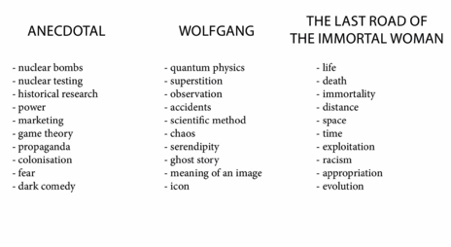
David summarised three projects using these bullets which served as a useful summary:
Project summary – David Fathi
David’s art allows him to take up his interest in the areas of knowledge, politics and science.
Three works are presented: Of these the first two projects, Anecdotal and Wolfgang are books. The next project, The Last Road …” moved on to become an installation.
Book: Anecdotal … nuclear bomb testing on own lands e.g US Nevada
Book: Wolfgang … Pauli Quantum physics, anecdotes of things going wrong, CERN archive
Installation: The Last Road .. Henrietta Lacks archive HeLa cells
In presenting Wolfgang in different contexts, David began to explore the installation as a way of publicly showing “The Last Road …”.
David felt he could have continued on in the vein he started (in some respects poking fun) but he was driven to do more serious work. Whilst earlier did poke fun it was also factual.
The work relating to Henretta Lacks, controlled the viewer experience as the installation layout meant the viewer walked between Dark landscapes with Hela cells opposite Intimidating text. A video played at the exit end in this liminal space. The video comprised film stills with an audio track that played louder closer up.
The migration to installations fell out from presenting Wolfgang creatively in numerous settings. Don’t let the form of archives seduce you. It is a danger. Maintain control. Control also by viewer walking between Dark landscape/Hela cells opposite Intimidating text. Video at the end shows film stills. The music gets louder with proximity.
Examples of stills given included the Film Godzilla as metaphor for the atomic bomb.
The talk highlighted ideas of balanced pairs:
mortality – immortality
personal – political
science – art
#Advice
Some take-away advice was “Don’t let the form of archives seduce you. It is a danger. Maintain control of your work”.
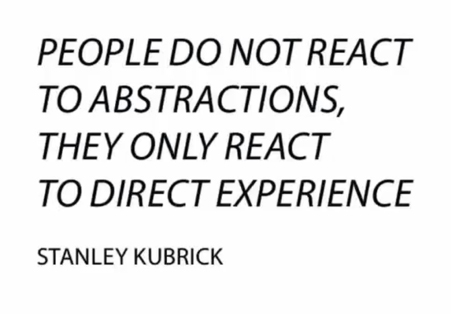
On the subject of abstraction, David quoted an observation by Stanley Kubrick:
Be self-aware of one’s art and the impact it may have. Stay true to one’s intent.
It is important to remain aware that work can transition from a book publication to an installation
I went back to watch this Guest Lecture video and make observations.
#Advice
Sarah’s many projects are formed though collaboration in the making. The work is very much out in the public domain. This was true of the Pickpocket performance work that used a professional pickpocket to set-up a reverse pickpocket as a means to training artists who are always being asked to contribute their work without a fee.
The many other works were also collaborations, mainly with the emergency services, regarding training for riots or fire, gunfire and explosions. These are dynamic interactions in the real world and end up in print.
An observation Sarah makes is around social coding and stereotyping in the scenes used for practice. Whether this is the type of furniture in a room or being briefed that a mother went to the shops and left her children in the flat where the fire is (an intention being to help stop fire fighters from identifying personally with the circumstances).
[metaslider id=2991 cssclass=””]
Advice included a point about get your work out there and show your work or it will never take off. It will remain under your bed.
The art business is very hierarchical in Britain when it comes to accepting photographic art. You don’t want to fall into the trap of making painterly work. Presumably, this relates to the photographer adapting to the gallery market instead of staying true to the foundations of their work.
The session ends with a call to making physical prints, Even small prints rather than exhibition size. Make them and move them around. This is especially important in an online environment such as our MA course.
Bibliography
Photographs – Sarah Pickering from Falmouth video lecture



 Critical Research Journal