The name Motherline is introduced into blog usage below as it is now being adopted. Motherline refers to the photography of healing wounds and the resultant abstract glow images from a digital post method.
Imaging Science
Long-awaited, the Symposium on imaging science took place at the University of Westminster. on Saturday 14 December 2019.
The opportunity existed to be introduced and meet people from the scientific and medical community. A number of those present were from the Kodak or Ilford companies and from the Universities or other professional bodies.
Imaging science participants were generous in giving their time to listen to the Motherline image glow and the post-processing techniques used.
Michael Turner based on UV image by Dr J CrowtherMichael Turner based on UV image by Dr J Crowther
A processed image was created from a UV image portrait captured after the Symposium talk Imaging the Skin – UV, visible light and IR
As preparation for attending the conference, research was conducted into image compression and decompression, as the techniques used in enhancing glow in Motherline photographs.
It became possible to describe to a medical forensic imaging expert the art interpretations of glow in healing and in return obtain vital and conclusive feedback.
A detailed discussion was had on the processing steps for potential infrared detection. The wavelengths for emanations from healing wounds at human body temperature are very long wavelength, well beyond consumer camera detection capability. The conclusion was that there will be no detection of IR emanation.
Where IR is received by a smartphone camera, in the example of the domestic remote control, the wavelength is short enough to be detected depending on the exact optics of a specific camera, lens and bayesian filter.
Blood Supply |Bacterial Fluorescence
However, in the project photography there is a glow present, so where does it come from? A general news article explains (Hrala, 2016).
Foremost is the presence of blood supply around a healing wound.
Potentially there is fluorescence present. Bacteria gather in the region of a healing wound. When excited by an external light source a glow will appear in the visible spectrum. A Japanese research paper examines this in detail (Koboyashi, 2009)
Detection used a cooled CCD in conditions of complete darkness. With a prosumer camera, there is no detection of direct bodily emanation from a healing wound. Rather than emanation, an external light source excites the bacteria and produces fluorescence in the visible light spectrum.
Both of these effects are the likely cause of the glow that appears in the photo project images.
The intention is to deliver something art-based (rhyme or graphic text or image titles) over the upcoming period between terms as noted in the Final Proposal. An intention is to experiment to discover if contextualisation and visual language can be built with Recombinant Rhymes or DNA Art.
The idea is to use imagination in selecting words like TELEOLOGICAL that contain DNA base letters ACGT and combine them for effect, perhaps making a video with a reading of a rhyme. Words are intended to be selected for their connection to narratives of the project.
Select from the following ACGT words for some connected meaning:
Examples:
Advocating
Fracturing conflagrations
Countervailing
Lethargic contagiousness
Interestingly, the validated list contains the terms Abstracting and Photographic.
Project naming
In short, “Motherline” is the name presently chosen. This is less politically charged than the earlier proposed project name “Matriarchy”.
Matriarchy like patriarchy has political overtones, so is not so attuned to the themes of the work.
Themes occur in several sets subdivided. First, are the now consistent outputs of the work, and second, the themes of visual narrative explored and third the set of the subject matter placed before the camera.
In turn, we have:
Out of abstraction, the theme set subdivided into
place as landscape/seascape/mountains of heritage and theatre of war;
ghosts ever more recurring;
depictions of inner/outer space.
Out of the physical and psychoanalytical, the theme sets are around language/communication and intent:
science mitochondrial DNA,
war,
the phenomenological – the weird/eerie/uncanny
Examples of the above can be found in this portfolio:
Portfolio by Michael Turner
There is the theme set of the subject and photography:
healing wounds,
museum (military and medicine),
family archive,
video (gaming and broadcast)
Generative art.
Examples of some of the above are also in this portfolio.
Portfolio by Michael Turner
In retrospect, this presents the analytical. To think in deconstructivist terms as in Derrida, it would make sense to home in on that which conveys the main feelings. There again Art Science (Artsci) as described by Arthur Millar brings scientific method back into scope. The latter demands more resolution by the artist. Millar points to the history of the avant-garde. The art world and gallery system had rejected impressionism and the likes of Picasso as surrealist. Artists then built alliances later their work being more established it became more widely accepted. Millar might argue the case for art-science as the new avant-garde.
In the case of accepting Millar, then the project proceeds as
Family Constellations
Family Constellations have allowed freedom from entanglement with ancestors and their narratives of loss in a war.
FMP Experimental
View the following as experimental imagery that is work in progress. This is not the end product of publishable standard at this early point.
The work is intended to be positioned within Modernism PHO705: Modernism. As abstract it may fit into the Art-Science avant-garde as a branch of Modernism.
The implementation is still open at an early stage. Developments in one direction are towards overlapping archive ancestry images of motherline and mtDNA glow images.
To go ahead, work needs to be resolved. As these firm, vestiges are present in other approaches.
War imagery, either from Museum exhibits or from video archives footage. There is the style of Natalia Goncherova with angels and flying machines compressed into the frame in a very claustrophobic way (as in her lithographs).
Science, as molecular biology, animation and Generative Art.
Further influences begin with Albert Steiglitz and images similar to cloud formations. This is closest to my type of work of any of the above approaches.
by Steiglitz
There persists influence from Picasso, in breaking bounds then Rachel Howard in terms of the hidden brush of gravity abstract style.
Thoughts about Resolution
More wayward approaches need to be set aside where project intent risks being diluted i.e avoid any negative impact.
The strong influence going into the Final Major Project FMP has been to resolve the visual language to make the abstract accessible to the viewer. This was achieved in a summer exhibition although the martial narrative need not be enforced was a consideration.
Having just stated that though, the war theme is necessary otherwise we lose the linkage and orphan the themes of place foreign and theme of ghosts recurrent.
The Symposium was long-awaited (August – December), and in terms of the ‘How’ element of the major project Motherline. The impact of ancestral identification was tested in discussion with imaging science professionals. Fortunately, the basis of the project once more stands when the premise is tested against science.
The input received on the methodology of making acted as a precursor for ramping up image creation which during the break has now taken off.
Recombinant rhymes and DNA Art is approached as supporting art either in creating Exhibition context or as part of a book, or indeed both.
The scope was set as words containing DNA base letters ACGT from which ‘poetry’ might be created. Originally this was inspired ‘double-strand poetry’ from a BBC Art-Science podcast.
Since the word list (circa 1100 words) was created for DNA using ACGT bases a second and partly overlapping wordlist (circa 500 words) has been created for RNA using its bases ACGU.
The idea would be to create a spoken-word recording and contextualising graphics for exhibition atmosphere and book in turn.
The atmospherics of playing spoken word was experienced at the Tate Modern exhibition of Natalia Goncharova’s work. In one area, viewers were funnelled through a corridor space that linked two functional areas. The corridor had its own smaller-scale works on view. Playing in the background was a recording of a Russian speaker whose voice created a wonderful aesthetic effect.
Example Russian speaker recording from the Tate exhibition:
During the summer exhibition. the atmosphere was created by video (and for a while using audio) and proved effective as a trial.
There were two students with our guest so a minimum group size on the day.
The other student went first whose work had already been reviewed amongst the cohort. Comment related to:
advice to drop text and focus on visual language.
a question about reverting to film process.
The recently named Motherline was reviewed and received reviewer comment. Questions related to clarification and comments were mainly of the checklist variety:
Was the intent exhibition? Yes. The summer exhibition led to a question about the level of comment received. This was recorded already within this blog. The reviewer wished to attend the Easter exhibition as the venue had been decided and dates needed to be pencilled in.
The previous portfolio settled on monochrome and red. It is interesting to re-discover the following quotation from an external to MA course, The Power of Colour. KLC School of Design.
The following colour interpretations are there to be agreed or disagreed with.
“According to Benjamin Whorf’s Linguistic Relativity Hypothesis, the language a person speaks determines how he or she experiences the world. This can affect how someone perceives colour. For example, the Shona language in Zimbabwe does not distinguish between red and orange. There seems to be a pattern, however, in the order in which all languages recognise colours: all languages appear to have a name for black and white, and if a third colour is recognised, that is red, and next comes yellow or green. “
“People who live in sunny climates prefer warm, bright colours, whereas those from places with less sunlight prefer cooler, less saturated colours.”
Quotations from KLC School of Design
There is a useful article What Colors Mean in Other Cultures. This proved useful in the past and so is brought into the scope of this blog post.
Colour Psychology has been extensively written about, and again here in Chivers and Wright. However, there is often a willingness to accept what is prescribed yet the verdict around any rules and interpretations is open in terms of there being no absolute scientific validity.
A re-exploration of the roots of Abstract in Bauhaus, Modernism, Post Modernism and Abstract Expressionism. Here, for now, a start is made.
This blog post serves as a reminder to revisit the developments that led to Abstract Art. This research was started in an earlier module. As there is a link to the chosen abstract genre for the final photo project, there is a reason to extend the reading.
Historic references are recorded here from external to MA studies:
Albers work gained mention in an external course on colour but did not gain mention within the scope of this MA blog other than a blog this week PHO705: Artist Jake Wood Evans. To right this here a quotation is taken verbatim from (Affron, 2012) Page 302 as it ties together a number of references:
“Itten’s tenure at the Bauhaus was notoriously marked by the increasing incompatibility between the Expressionist and esoteric impulses of Ittenand his cohort and the functionalist ethos for which the school would become known. That tension is latent in Josef Albers’s Gitterbild (Lattice Picture), also known as Grid Mounted … Working on this piece as a student in the glass workshop of the Bauhaus, Albers cut and arranged squares on manufacturers’ samples of glass within a regular metal lattice. On the one hand, this straightforward grid composition foregrounds the materiality and variety of industrially produced glass, divested of the conventional esoteric connotations of coloured glass panes, for example in church windows. (Albers had created a stained glass window for a church four years earlier, and he would have been thoroughly familiar with the mystical connotations of stained glass). And yet, as light passes through Albers’ grid, Kandinsky’s immaterial fantasy of unbounded colour returns, finding subtle expressions through the chromatic emanation of light.”
(Affron. 2012) Page 302
Gitterbild (Lattice Picture) / Grid Mounted Josef Albers
The above plate is from the book Inventing Abstraction (Affron, 2012)
Alfred Stieglitz
Stieglitz work (Birgus, 2002) Pages 44 and 45 have visual similarities with the earlier portfolio images created for the MA as well as the current crop of images. Interestingly the 4×5 print format is common.
[metaslider id=3845 cssclass=””]
Images – Alfred Stieglitz
Laslo Maholy-Nagy
Having read photographic theory expounded by this writer and artist, and now having viewed a particular image, a chord has been struck. It concerns the appearance of the Christian symbol of the cross as it recurred in earlier work in the build-up to the MA portfolios.
In memory of Sibyl Maholy-Nagy – Laslo Maholy-Nagy
Wassily Kandinsky
Kandinsky is linked in the quotation above and has been previously blogged.
Affron, M., Bois, Y. and et al (2012) Inventing Abstraction 1910-1925. 3rd 2014. Edited by D. Frankel. New York: Department of Publications Museum of Modern Art. Available at: http://www.thamesandhudson.com.
Birgus, V. et al. (2002) Die Kunst der Abstrakten Fotografie The Art of Abstract Photography. Edited by Jager Gottfried. Stuttgart, Germany: Arnoldsche Art Publishers.
Attention was drawn to Irish artist Jake Wood Evans painting style.
Connected here is the use of Turner family archive photographs mixed with abstract art which has been trialled. Also, similar is the work of Susan Hiller – Aura, already referenced in this blog,
Paintings – Jake Wood Evans
There is something similar in intent. The final photo project images almost exclusively in black and white may benefit from hand colourization before mixing with mtDNA abstract art images. A basic sepia colouration might be a start.
What could be quite exciting would be the use of some muted or bold colour theory – this is getting quite exciting. Some practice and reading (Albers, 2013) and (Quiller, 2002), were conducted as part of the project research in an earlier module.
Also attended was a four-week course on The Power of Colour presented by the KLC School of Design. Colour theory also makes a regular appearance in Studio photography workshops at work.
Bibliography
Albers, J. (2013) Interaction of Color. 4th edn. Yale University Press. Available at: yalebooks.com/art.
Quiller, S. (2002) Color Choices Making Color Sense out of Color Theory. New York: Watson-Guptill Publications.
As current research continues into Phenomenology and mtDNA, a break is taken to cast ahead to publication. The work has to be taken to the public and is still experimental as shown in PHO705: WEEK 9 REFLECTION. Some of the making stages in the plan will arrive soon enough.
It makes sense to gather some direction even though the desire is there to complete work in progress reading as mentioned in PHO705: WEEK 10 REFLECTION.
Thinking through one idea here has a purpose of creating a Strawman. This will have enough form or structure or clarify the artistic design. This idea is about a book and starts with Ghost images. These creations appear fleetingly and have to be captured before they disappear. There is a need to conquer this and to avoid there being no work of this type to show. Apparitions are always welcome to this work but the nature of creating them is open to the random. A perhaps predictable but nevertheless still surprising element of this randomness occurred during a period of distraction in which Ghost images began to appear in other made work, outside of the main project. Perhaps these intrusions are just another type of Ghost, linked to the main project by occurring during the project timescale.
In the previous module, an attempt was made to help progress by restricting image scope to abstract Landscape. At first, this was a mistaken choice. As with Ghosts, Landscapes are also subject to random process but nevertheless, they regularly feature in the work.
The experience was somewhat worrying as having restricted scope to landscape the theme was worked towards for a solid two weeks and the worst – no Landscape could be made. Letting intuition take over the method of obtaining the desired result was finally fathomed. A way of making at will was settled on which largely depended on recognising the kind of processed starting image that might work. There is an earlier Landscape representation with horizontals and verticals that would have been readily obtained from the start, which may still feature as published work, but what it had led to was a more imaginative scene that required more sophisticated processing more akin to perspective images as compared to earlier flatter images.
All this is taken as a lesson learned around the intuitive making versus something closely allied to a ‘commissioned’ approach.
The Week 9 reflection above turned up a Ghost of the kind sought. But what if that was it? in this case, it might be necessary to showcase the image as a full-page and in a process of categorisation accompany it with earlier ghost images as a plate of smaller inserts.
There is a process of categorisation that would work equally as well with the works other representations (seascapes/mountainscapes and spaces inner/outer). Each theme is linked phenomenologically with narratives of the work but each would stand as page layouts again of main plate and plate of earlier images at a smaller scale.
This is not the final piece, but thus far it has an appeal. It leads to making and it does so in a structured way and way familiar to the author and in some respects reflective of Victorian categorisation schemes e.g. in Botany.
To take this a stage further is to keep a keen eye on an Exhibition element of publication. Having learned from visits of a knowledgeable public to a Summer exhibition of recent work, the idea would be to take from this experience the things that worked well with the audiences especially around sequenced narrative and incorporate it into the same book design mentioned above. A book section that parallels an Exhibition.
There then becomes a substantive element of making to propose and gather feedback on from the University regards the standards of the MA Photography course. It would also be necessary to maintain balance, i.e. not try and squeeze a long term project into the remaining time on the MA.
What this is about is the practicalities of making images of publishable standard, about a book and about an exhibition.
There are extras planned either to assist the design such as using ISSUU as a template for hand, bookbinding. Or, to help create impactfully contextualisation by making moving stills and or a video. This created the atmosphere at the earlier summer exhibition.
The exhibition has some elements that are rooted such as the available space and the possibility for lunchtime pop-ups during appropriate photographic training sessions. Some elements would be more aspirational at present, such as making society presentations at one or both societies with which there is an affiliation. This is a likely outcome but does not have to happen within the timeframe of the MA, it can follow on. Another group or in fact two groups have made approaches although generally so and not so much around a specific project.
The aspirational elements represent To-do action if something is to be achieved. For the purpose of the MA and continuity, it might make sense to negotiate with the various societies and groups, the further taking of the work to public view but time this to allow freedom to complete substantive work for the MA without too much self-imposed overload.
As research continues into Phenomenology and mtDNA thoughts cast ahead to publication – PHO705: THINKING ALLOWED/ALOUD. In a sense, this has been a reflection upon recent refections and keeps in mind the need to take the work public.
The blog post PHO705: Artist Jake Wood Evans led to quite a bit of inspiration over colour. Colour has previously been worked on where it settled. In other words, the colour palette settled on monochrome and red as the preferred colour scheme. The reason for mentioning this is that whilst the references are very useful and interesting, the value of making a deeper dive could have limited value other than polishing work as there is already a developed sense of colour from work practice and ongoing development of colour in the projects developed for this MA Photography course.
While PHO705: Thinking allowed/aloud cast ahead to possibilities for making. This made a break from the intensity of research themes; of Phenomenology and the biological in terms of mtDNA.
In the background, research into Phenomenology in relation to the final photo project continued in spare moments. This will need to be taken under closer control to prevent reading from becoming too open-ended.
It is beginning to be sensed how much more time needs to be spent researching topics that can become very open-ended. IT has been quite a luxury being able to spend the time so far and this has aligned with such matters as continually being laid dreadfully low as bug resistance seemed to almost disappear for the majority of the Final module.
Whilst reflecting on colour, a seminal work was re-discovered that is available in PDf form. (Itten, 1970)
There are different commercial services that provide DNA testing connected with ancestry. One service is mentioned here as they have an option to have a personalised book and that fits well with researching visual language of DNA. Two services were inspected:
This is a continuation of earlier research. It looks at a specific book product of commercial DNA testing. The idea is to gain awareness of public perceptions around DNA by examining the visual language used by a company promoting DNA testing.
This current phase of research is prompted by the order and eventual arrival of a personalised analysis “Your DNA Adventure” (LivingDNA, 2019).
The content is predicated on three types of DNA we possess.
Family Ancestry (autosomal DNA)
Motherline Ancestry (mtDNA)
Fatherline Ancestry (Y-DNA)
As the photo project majors on the Motherline (a term now preferred to matriarchy as it softens potential for feminist bias.
The motherline is highly stable over thousands of years and once a change does occur it is passed down to descendants. The top-level term used is Haplogroup within which exist Subclades.
Descriptive language then takes over preventing opaqueness and is a strategy noted elsewhere for keeping others engaged.
There is a very good reference section to explore.
Within the publication the visual themes range across:
trees on African savanna (covers)
Note: The visual references are probably best viewed as a publication rather than my translate to text here.
Bibliography
LivingDNA (2019) Michael Turner – Your DNA Adventure.
Alex is a Commercial Photographer working over several decades on marketing and publicity for film and television.
He described how this work is delineated and gave examples of commissioned work, a concept sheet and a mood board.
As we as students have learned to do, Alex for the first time was faced with making a presentation of; his own influences; what brought him to photography and which book and photographic names encouraged him to become a Commercial photographer, one who brings his own artistic integrity.
Key aspects of career had been: the opening up of the closed shop practices that existed prior to the Thatcher political era, and the impact of the transition to digital on technical and business practice.
The practicalities of commercial practice were illuminated. The passion Alex has for his subject is clear.
Personally, what was said resonated clearly with some fairly recent education on the film industry. This industry is active in the local region around London.
Copious notes were taken. I shan’t dwell on this lecture even though it was thoroughly enjoyed as a contrasting practice to my own. Seeing Alex’s work and getting such insight into his contrasting practice was a great help in understanding my own practice.
PHO705: Guest Lecture Alex Bailey The life of a commercial photographer is different from that of abstract art although attaining an artistic interpretation was key to both. This lecture resonated with recent past studies in film.
Reading continues with Photography and the Optical Unconscious (Smith, 2017).
There remains a backlog of reading material with Phantasmagoria (Warner, 2006); The Weird and the Eerie (Fisher, 2016), Memory of Place (Trigg, 2013); the Body Keeps the Score (Kolk, 2015).
Competition between themes meant a switch for Phenomenology to mtDNA. Time did need to be spent on visual research of mtDNA. There is a need to switch back to the Phenomenological in Week 11.
There is a growing need to further develop photographs in the digital darkroom if work is to be shown. The last update was in PHO705: Week 9 Reflection.
Bibliography
Miller, A. I. (2014) Colliding Worlds – How Cutting-Edge Science is Redefining Contemporary Art. New York and London: W. W. Norton and Company. Available at: http://www.wwnorton.
Smith, S. M. and Sliwinski, S. (2017) Photography and the Optical Unconscious. eBook. Chicago, US: Duke University Press. Available at: https://lccn.loc.gov/2016048393.
Backlog
Fisher, M. (2016) The Weird and the Eerie. London, [England]: Repeater Books. Available at: https://www.repeaterbooks.com.
Kolk, B. Van Der (2015) The Body Keeps the Score Mind, Brain and Body in the Transformation of Trauma. Penguin. Great Britain: Penguin Random House UK. Available at: http://www.greenpenguin.co.uk.
Trigg, D. (2013) The Memory of Place A Phenomenology of the Uncanny. Athens: Ohio University Press. Available at: http://www.ohioswallow.com.
Warner, M. (2006) Phantasmagoria Spirit Visions, Metaphors and Media into the Twenty-first Century. Oxford, United Kingdom: Oxford University Press.
Following the visit to the Wellcome Museum, it was clear that others must be working in an area where art is created from science.
Artsci is the term coined in the book (Miller, 2014) where Artsci acknowledges a convergence of Arts, Science and Technology.
Colliding Worlds – How Cutting-Edge Science is Redefining Contemporary Art (Miller 2014)
The work in bulk extensively sells the market for Artsci, by giving innumerable personal reflections on individual contributor after individual contributor, yet this is rebalanced in the final chapter by doubts over the acceptance of Artsci in restricted / specialist galleries being deemed almost gimmicky as an art form. However, examples are made in the ending of the rejection of Picasso and the Impressionists who had to set up their own groups. And so it is left to the reader as to whether or not to take up the “cause” of Artsci.
Millar describes the technical evolution of technology in computing in this book (Millar, 2014). So much resonates with my early career in technology as a world in which artist and scientist no longer are viewed strictly different disciplines. Art and science and engineering are disciplines seen as having a conceptual touchpoint in terms of methodologies e.g. minimalism and cubism.
An electronic signal called a butterfly transform, photographed on Polaroid film, was one of my earliest technical visualisations. I designed and built an electronic circuit to automatically tune to a signal frequency of a type used to communicate with deep space satellites. The active tuning process was viewed on an oscilloscope and the overall capture presented on film. During development one of the early characteristics was that of a squegging oscillator which pulsed on and off due to design tolerance issue in this automatic circuit. This was around the time that a successful MSc application was made to study the subject of Cybernetics that involves the control of machinery using feedback and software controllers. A funding issue arose that prevented the place from being taken up. Besides this, an economic downturn occurred that would certainly have blocked an immediate return to research and development within the industry.
The book runs a direct parallel to my early involvement in computing, discusses the various technological art movements and the establishment of schools for such art.
The book also discriminates between Media and Fine Art the former being linked to crafts and it notes the rejection that occurred on many fronts.
However, with repeated incursions of technology into art and advances in the modern world, it is argued that contemporary art can no longer exist without the structures and knowledge of the scientific world and they are seen to combine.
Artists are seen to look towards science and without getting directly involved with expensive equipment instead read the ideas and then through contemporary art communicate these ideas. Scientists look towards artists to understand how they approach a topic e.g. Nils Bhor and the wave-particle dichotomy of physics and the resolution of this through Picasso and the advent of Cubism, where it is fine to have multiple perspectives present all at once.
The question has to be where does this lead to in terms of the Final photo project? Well, it resolves why the author takes a technological view of art and provides an independent and solid standing. The intent of the work becomes understood in the wider context.
The book identifies the avant-garde as being the convergence of art, science and technology and it is seen as an exciting frontier in Contemporary art.
There is a summary for Antony Gormley, his influences including in science, and his work which was on display in London during visits there.
Another outcome is a strengthened resolve so as to honour or be true to one’s life experiences. Otherwise work would remain conflicted.
Had this work been uncovered earlier in the course, there would have been the time need to develop programmed work such as animations. These would be over and above the glow images attributed to mtDNA. What there is also are elements of identification (determined through psychoanalysis).
The book has been difficult to put down and yet the historical side has to stop at some point to allow time for project progress.
Computational Biology – Human Proteome Folding
Following a career in research and development in electronics and computing, sometime later, there was a formative even if only a side involvement in grid computing donating spare machine cycles to do then return completed calculations to researchers in computational biology. This was in the search for new drug treatments.
Specifically, spare machine cycles were donated to human proteome folding projects. These projects are highly visual as protein formation and attachment is shape-dependent.
These projects go back to around 2004 and there is little visual material remaining. In lieu of this, a TEDtalk was discovered that ably shows the visuals (Dill, 2013).
For 50 years, the “protein folding problem” has been a major mystery. How does a miniature string-like chemical — the protein molecule – encode the functions of living organisms: how our muscles exert force, how our immune systems reject pathogens, how our eyes see our surroundings, how plants convert solar energy, and all the rest. Huge progress is being made. Moreover, these amazing nano-machines could play important roles in health and disease and commerce in the future.
(Dill, 2013)
What this post identifies is what is behind the intent in making the photo project.
Art of Now
Research uncovered a BBC Radio 4 broadcast Art of Now. (McNamee, 2019)
Recombinant Rhymes and DNA Art
The successful sequencing of the human genome has not only had huge implications for medicine, bio-technology and the life sciences – but it has also provoked a great and growing reaction among artists and writers.
Anna McNamee meets poets, visual artists and scientists collaborating creatively on the frontiers of DNA science in a genre that Pulitzer Prize-nominated author of AI Renaissance Arthur Miller calls Art Sci.
In Melbourne, the bio-animator Drew Berry tells how his dramatic but scientifically exact visualizations of cellular and molecular processes have earned him fans around the world – including the musician Bjork.
The poet Sue Dymoke and the structural biologist Pietro Roversi reveal how their creative partnership has resulted in a three-dimensional, topsy turvy poem called DNA Time that mimics DNA’s unique and complex structure.
In his lab, the Canadian experimental poet Christian Bök has successfully encoded his work into the DNA of a bacterium creating what is essentially a living poem.
While at the European Bioinformatics Institute near Cambridge, the artist and filmmaker Charlotte Jarvis and the scientist Dr Nick Goldman have stored music in DNA which they then suspended in a soap solution and used to blow bubbles, quite literally, bathing their audiences in music.”
(McNamee, 2019)
Drew Berry
Drew Berry is a biomedical animator at the Walter and Eliza Hall Institute of Medical Research in Melbourne, Australia. He produces animations of proteins and protein complexes to illustrate cellular and molecular processes (Berry, 2011).
Wikipedia
Animation Development
Berry describes the molecular level being sub-light wavelength and how he gained inspiration from the accurate scale drawings of David Goodsell:
Beyond this Berry incorporates measurements of cell dynamics and microscopic observations of larger cell structures to create his animations. His intent is to make work that viewers can take-in with avoidance of technical descriptions and acronyms which otherwise make the subject opaque and turn off the viewer (Berry, 2012)
Animations from Berry and molecular biologists and cell biologists:
Miller, A. I. (2014) Colliding Worlds – How Cutting-Edge Science is Redefining Contemporary Art. New York and London: W. W. Norton and Company. Available at: www.wwnorton.com
Having recently communicated progress and details of research themes for the Major Project, the action has triggered several responses in terms of recommended reads. The objective remains to build research into the contextualisation of practice while developing the visual language.
This blog post concerns Phantasmagoria Spirit Visions, Metaphors and Media into the Twenty-first Century. (Warner, 2006) Ideas of “spirit”, “soul” and the “supernatural”.
Summary
The book (Warner, 2006) challenges why it still is that in the 21st century we revert to ideas of “spirit”, “soul” and the “supernatural”.
Scanning through this text there are two areas of immediate interest with regard to the photo project. First is a quotation.
“You are on a mission to discover
why the human heart still slows
when divers break the surface,
why mermaids still swim in our dreams”
“Michael Symmons Roberts, Mapping the Genome”
With a project theme majoring on DNA there is almost a necessity for discovering why Warner included a reference to the Genome. (Warner, 2006) opposite Page xviii
Further search shows that Symmons Roberts in 2003, soon after the Human Genome was decoded, penned another poem about the Mapping of the Genome and written in a metaphorical style of a car journey along a seemingly unending straight desert road.
Other areas of the text that prompt immediate interest are Part V Shadow Part VI Mirror: Double Vision, The Camera steals the Soul, and Part VII Ghost: Stay this Moment, Julia Margaret Cameron and Charles Dodgson; Spectral Rappers, Psychic Photographers.
Topics with a stronger connection to photography than literature demand more attention in the project context.
Online Video Lectures
The book author is a renowned presenter and her interviews, presentations and lectures are available to view online. This gives quite a quick view over a range of subject matter.
Much of what is presented is based around stories and fairytales and is literature-based rather than strictly photography based.
Quotation
Bibliography
Warner, M. (2006) Phantasmagoria Spirit Visions, Metaphors and Media into the Twenty-first Century. Oxford, United Kingdom: Oxford University Press.
Research has become focussed on the Psychoanalytical for example in terms of ghosts. And as below the ideas of Science in Art have been explored.
Work in Progress: There are some textbooks to finish researching.
To Do: Other books on the history and development of abstract art, hanging over from a previous module. The importance here is to more fully develop an understanding of the evolution of the art. Also, there is a desire to contrast and compare with other artists abstract work to fix in place the photo project.
A collection of FMP photographs has been catalogued and are in the backlog queue and production rate has picked up. Photography of healing continues and images are being processed. In one case it was a relief to obtain the first Ghost image of this series:
Week 9 Revenant 1 by Michael Turner
Another image is of a graphic type and serves as a representation from DNA testing and might be expected to form an image layer as part of the contextualising process.
Week 9 DNA Analysis by Michael Turner
Some colour images have also been made while ideas are being formed. As such they are individual examples of technique or aesthetic stylisation. The main priority has been to maintain practice – concentrated periods are need to explore and develop the image types.
Here is this week’s example of a glow image:
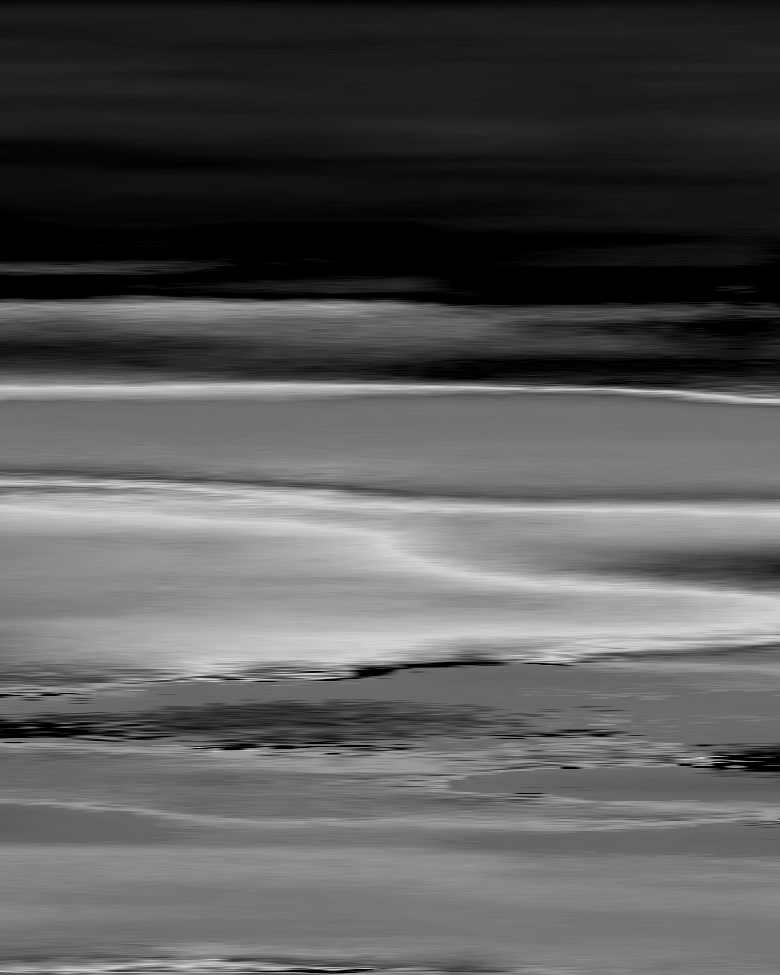
Week 9 Untitled by Michael Turner
This week’s example of an abstract Landscape image:
Week 9 Landscape by Michael Turner
A rendition of a pure abstract in Week 8 harks back to the saturated colour theme from earlier portfolios. There is a personal joy to this image as at exhibition in the summer there were requests for two such images to be made complete with a third. This looks like the missing third image:
Week 9 Colour Abstract by Michael Turner
At present these are partial works and it is plain to see there is no attempt at consistency as ideas remain open. Once the direction is decided the work can properly proceed.
Social interaction occurred in making this week and was a joy too. This continues to be motivational. The making is also a pleasant break from the reading and research.
This post connects an earlier technological career with an analysis of this scene as a motivator in the current photo project and stands alongside the more psychoanalytical regarding the strangeness of abstract images created.
In creating the post the photo project became more connected. Answers were found to questions such as how animations at the cellular and molecular levels were resolved. Further validation and extension of an understanding of Biology occurred. This allows the topics to spoken of with greater clarity. The connection between Biology and Art was explored and parallels drawn with art forms such as poetry and music.
It is clear that recent medical progress is so significant that we have entered a new era and as we do so we witness the integration of Art, Science, Engineering and Technology into a new field simply described as Research.
Guest Lectures
One of two Guest Lectures was blogged as the Week 8 lecture was replayed in Week 9. Guest Lecture with Andy Hughes. Andy talked about the environment in terms of plastics and global warming as well as the making of a film using a gaming platform.
Here is the lecture. The main photographic project is based on letters between sisters over a hidden relationship that of a secret transgender female Ken married to one of the sisters known as aunt Hazel. All this was at a time when there was no recognition or language to frame identities.
Identity was sympathetically dealt with and Ken becomes K(ay) and her or she.
There is a book “Ken – to be destroyed”. This began as a small personal project but created an unexpected level of interest. The conversation led to working on the project and exhibiting in Liverpool. There were uncertainties from gaps in the texts.
Sarah found more including family photographs. As she worked with the materials this led to working physically in the darkroom as a natural extension of handling physical materials. The working with a family archive was a first for Sarah.
The work is robust having nowadays a universal message of identity. The work presents well as small groups of images and as a book.
The book was a collaboration with Val Williams who helped with the edit that combined family archive material with Sarah’s work. Working collaboratively proved very useful.
Both Sarah and today’s host began their artistic lives as painters.
The personal aspects were seen to be of interest to audiences. There is a universality of family with all the problems family present that viewers can insert themselves into.
Another aspect of the German Jewish family is the next piece of work. It is still, based on family history but now covers the Holocaust. The project is approached from a very personal perspective and in an intimate way. An album carried on the Kindertransport is a material source for this new work.
Final Photo Project
Sarah’s project was allowed to develop and that is important compared to planning exactly how the work should be from the outset.
A point in common is the use of family archive photographs. High-resolution scanning, alternative processing of the images and concentrating on the surface condition are strong elements of Sarah’s work. Obliteration of identity became a step in which aunt was translated into clothing only or into the uncle.
This compares with using the photos for the final photo project which are scanned for smaller size reproduction. The idea was not to overwhelm the abstract images at the core of the project. Recently one image from the archive was layered with an image of mitochondrial glow and connecting thus with an ancestor from the maternal line. This has a key significance.
The history of a family is also common as is the impact of 20th-century war.
Bibliography
Photographs Sarah Davidmann from Falmouth Guest Lecture




 Critical Research Journal