Photographic Inspirations from Expressionist Movements

If asked to describe my work in photography, I would reply Conceptual, Abstract, Expressionism and so I was sad to have let pass the Tate Exhibition “Expressionists: Kandinsky, Munter and The Blue Rider”, 25 April – 20 October 2024.

There are some videos posted on YouTube that folks have create of the Exhibition, such as an introductory talk and a perception of what the exhibition was like.

A couple of points I was fascinated by were the revisit to the idea of art created from personal experience and of the spiritual, both items I can identify with from a Final Major Project – Past Present 2020. The other was the discontinuance of the Blue Rider movement due to the start of the Great War that led me to discover how Expressionism did continue on, albeit in other movements.

I was pleased to discover or reaffirm the following taken verbatim and for reference here the ideas from a brief analysis:

Key Continuations of Expressionism:

1. Die Neue Sachlichkeit (The New Objectivity) – 1920s

After the war, Expressionism split into different strands, one of which was Neue Sachlichkeit, a movement driven by disillusionment with idealism and a focus on realism and social critique.

Key Artists: Otto Dix, George Grosz, Max Beckmann.

Their work retained the expressive distortion and intensity of early Expressionism but was now focused on grim reality, the trauma of war, and social injustice rather than the mystical themes of Der Blaue Reiter.

2. The Bauhaus & Expressionist Influence

Wassily Kandinsky, one of the key members of the Blue Rider, continued his exploration of spiritual abstraction at the Bauhaus (founded in 1919 by Walter Gropius).

While the Bauhaus is more associated with modernist design and functionalism, Kandinsky, Paul Klee, and others maintained the Expressionist idea of inner necessity and spiritual abstraction.

Key Themes: Pure abstraction, colour symbolism, and form as a means of spiritual expression.

3. Scandinavian & Nordic Expressionism

Edvard Munch, a precursor to Expressionism, continued painting through the 1920s and 1930s, exploring psychological states and existential themes.

Nordic Expressionists such as Emil Nolde (despite being linked to Nazi Germany) maintained the tradition of intense colour and personal vision.

4. Abstract Expressionism (1940s–50s)

The spiritual aspirations of Expressionism found a new life in Abstract Expressionism in the United States, particularly in the work of:

Jackson Pollock, who explored automatism and the subconscious.

Mark Rothko, who aimed for spiritual transcendence through colour fields.

Willem de Kooning, who distorted figures in a way reminiscent of German Expressionists.

Many German Expressionist artists fled to the U.S., influencing the development of modernist abstraction, particularly through exile artists like Josef Albers and Hans Hofmann.

5. Postwar German Expressionism (Neo-Expressionism, 1970s–80s)

The 1970s and 1980s saw a revival of Expressionist concerns with personal experience, intense colour, and distortion in Neo-Expressionism.

Artists like Anselm Kiefer, Georg Baselitz, and Jörg Immendorff drew upon the themes of war, memory, and existential struggle, echoing the psychological depth of earlier Expressionism.

Summary

While the Blue Rider movement ended with World War I, the core Expressionist idea of conveying subjective experience, emotion, and the spiritual in art continued in many different forms:

Social critique in Neue Sachlichkeit.

Spiritual abstraction in Bauhaus and Abstract Expressionism.

Psychological depth in postwar and Neo-Expressionist art.

For my part I take from this the named artists as a source of further research, which for me will bias towards photographic art.

Already on my radar are Rothko and Albers so some new names to follow up on Abstract Expressionism. Also, the mention of themes of war, memory, and existential struggle are prescient. In particular expansion of the existential aspect of former struggles and our gains since may be a extension of my work.

I’m glad to have come back to my Blog if only to store this information so it is not lost to me. The fire is re-lighted.

Hauntology

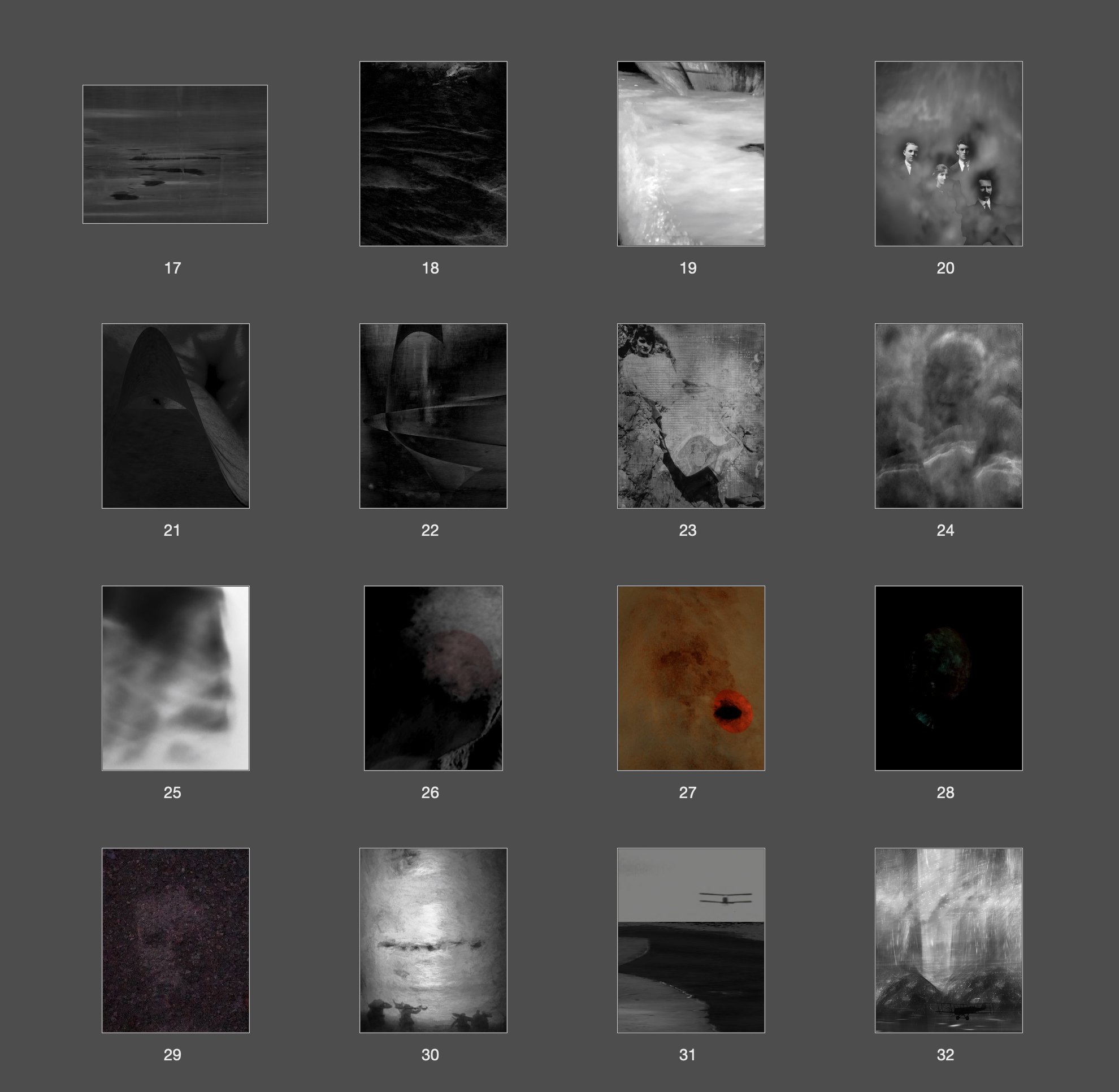
I extended research in a number of directions to include a self made music piece following a visit to the University of Westminster in December 2019 and attendance at basic instruction on creating music with GarageBand in the nearby Apple Store. This composition was in a Hauntology style and recently in expression has evolved. I also created a video using iMovie that by now is due an update with a refresh of the images used, Parked still are a number of my processed ghost images that have never been shown outside of my course. All of these mediums: sound, video and visual extend somewhat eerily into the realm of Hauntology.

Of Phenomenology and Hauntology

Hauntology is a range of ideas referring to the return or persistence of elements from the social or cultural past, as in the manner of a ghost. The term is a neologism first introduced by French philosopher Jacques Derrida in his 1993 book Specters of Marx. It has since been invoked in fields such as visual arts, philosophy, electronic music, anthropology, politics, fiction, and literary criticism.

“Hauntology” originates from Derrida’s discussion of Karl Marx in Spectres of Marx, specifically Marx’s proclamation that “a spectre is haunting Europe—the spectre of communism” in The Communist Manifesto. Derrida calls on Shakespeare’s Hamlet, particularly a phrase spoken by the titular character: “the time is out of joint”. The word functions as a deliberate near-homophone to “ontology” in Derrida’s native French.

Derrida argues that Marx’s ideas are still relevant today, even though he died in 1883. He writes that Marx’s ideas “haunt” us, in the sense that they are always present, even if we are not always aware of them. Derrida also argues that Marx’s ideas are not simply a matter of the past, but that they have the potential to shape the future.

The concept of hauntology has been used to explore a wide range of issues, including the relationship between the past and the present, the nature of memory, and the possibility of social change. It has also been used to analyze a variety of cultural phenomena, such as the rise of nostalgia, the persistence of colonialism, and the return of fascism.

Hauntology is a complex and challenging concept, but it is also a powerful one. It can help us to understand the past, the present, and the future in new and unexpected ways.

Ginko Walk and Haiku Verse

Brick Lane to Weavers

During an RPS London exhibition at the Espacio Gallery on 23 April 2022, a group of us met up to go on a Ginko Walk with leader Stewart Wall

Project Ginko and Haiku Visual Language

Project Ginko is a photography led research project by Stewart Wall that involves photo-walking in nature observing things, where nature can mean any landscape the photo-walker chooses. The photo-walker uses photography to record the observations and then uses the photography to inspire free-flow writing of haiku verse, that in turn provides an opportunity to think more about the meaning of the image, although haiku is not intended to describe the image.

Haiku originated in Japan as an opening part of a larger poem called renga, which is a term used for collaborative poetry, linked in succession by multiple poets. Project Ginko is about all the individual projects that it inspires, that together make up one mass observation of contemporary life and how humans use space and place to experience life itself. Stewart was inspired to initiate the project when he read a Phaidon 55 book about a Japanese photographer called Shomei Tomatsu, whose photography was described as haiku. This led to Stewart researching the wider concept and meaning of haiku, asking how photography can be referred to as haiku*. You will notice there are few capitals, commas and full stops used, which is part of the haiku tradition, although I am still reading more about those aspects. The design of our project Ginko books is inspired by the Phaidon 55 books.

* As for Stewart’s research question about how photography can be referred to as haiku, here are a few ideas:

  • Use simple, clear visual language.
  • Focus on a single moment or scene.
  • Use natural elements to create a sense of place.
  • Use light and shadow to create mood and atmosphere.
  • Leave some things to the imagination.

In summary, visual haiku is a type of photography that captures a moment in time in a simple and evocative way. It is a great way to express your creativity and to share your vision of the world with others.

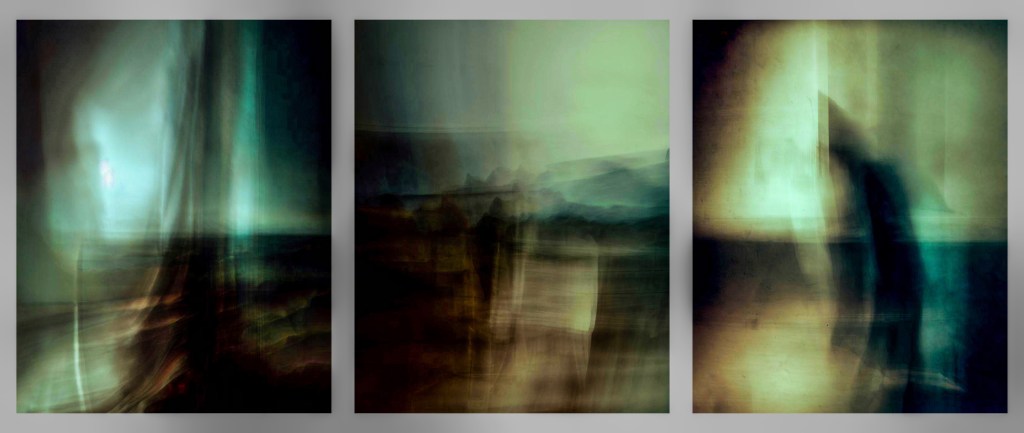
During the day in question, I discovered that taking a slow walk presented me with numerous opportunities to reflect on my framing, relook at the subject and reframe. This resulted in two images which when combined during post processing create a narrative, a story of how this was processed in the author’s mind.

I wrote some Haiku verse to accompany the unconventional composite images.

Inspiration was drawn from French post-structuralist ideas, particularly those put forward by Jacques Derrida, such as deconstruction and phantasmagoria.

I am extending my existing photographic practice strand based on deconstructionism and phantasmagoria by working in slow time and making a second exposure that opens up the subject into overlapped composites with jagged frame with an inherent narrative. This new approach allows me to explore the relationship between reality and illusion, and to create images that are both visually arresting and thought-provoking.

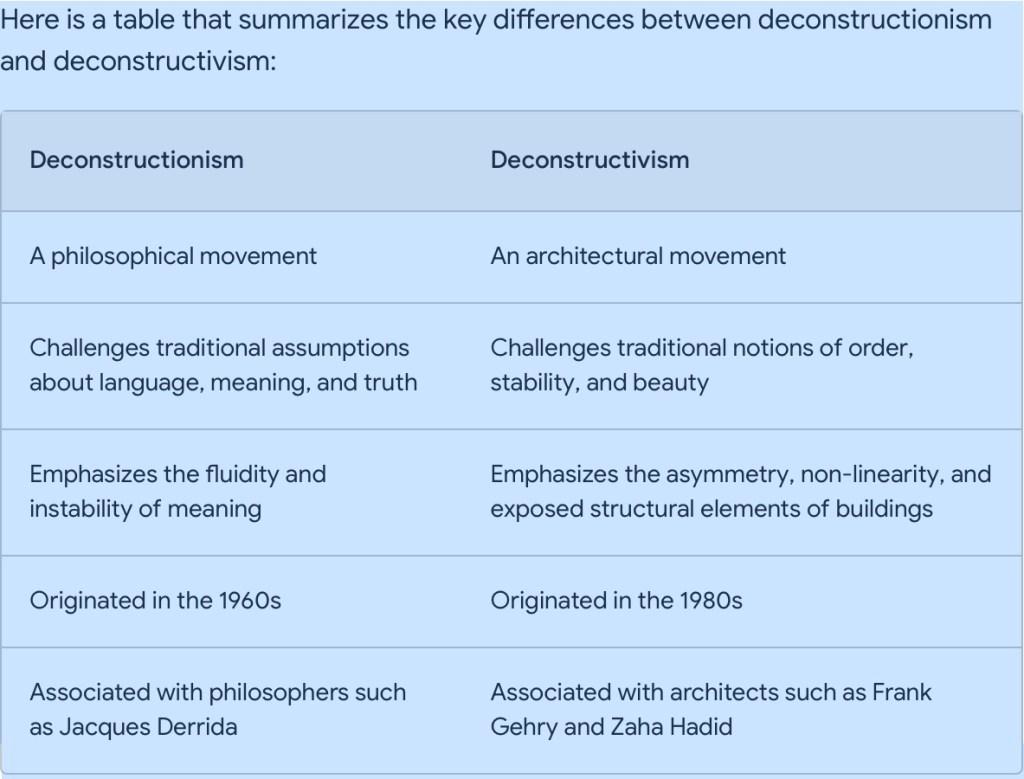
In my previous work, I have used deconstructionism (language, meaning and truth; fluidity and instability of meaning) and now introduce deconstructivism (impression of fragmentation, absence of obvious harmony, continuity or symmetry) to challenge the traditional notion of the photograph as a window onto the world. I have toned this down and move away from emphasis on conceptual methods with experimental post processing cropping, image stretching and collage and adapt it here to create images that are more true to representational even if fragmented and unstable. These new images call into question the idea that photographs can provide a truthful representation of reality.

My earlier work, represented surreal landscapes and branched into ghost images and phantasmagoria. Phantasmagoria is a technique that uses light and shadow to create illusions. I still use this technique here to create images that are both real and unreal, both familiar and strange. These images evoke a sense of unease and mystery, and they invite the viewer to question our perceptions of reality.

The jagged frame that I use in my new work is also significant. The jagged frame creates a sense of tension and instability, and it reinforces the idea that the images are not to be taken at face value. The jagged frame also serves as a reminder that the images are created by the photographer, and that they are not simply a reflection of reality.

I believe that my new approach to photography has the potential to create powerful and thought-provoking images. I am excited to continue exploring this new direction in my work, and I look forward to sharing my new images with the

Another Perspective on Layering

Chris Coekin and Noel Nasr conducted a funded project recreating the visual journey of Bob and Anne who visited Lebanon in 1973 taking photographs with a Viewmaster 3D camera which these photographers recreated with two identical medium format film cameras. The distance is always other as a book is limited edition supplied in a cardboard box and includes a viewer with a carousel of the original images. These photographers took two 2D photos and scanned them together as a 2D photo showing the shift.

The 3D element is deemed gimmicky. The point is about the shift.

Instagram @chris.coekin @noelnasr

Reference

Tofeili, F., Coekin, C., Nasr, N., & Abedini, R. 2018. The Distance is Always Other. Publisher Dongola Press

https://www.noelnasr.com/5428758-the-distance-is-always-other

Reference: Deconstructionism versus Deconstructivism